
Picnic Panic
The Untamed Life of Matilda Pepper

A phone is ringing, and I realize it’s mine, the sound flowing from my open window to Edith’s. I glance at Edith, who is dozing in her chair, and dash home to answer it.
“Mattie,” Paul says when I pick up the phone. “Why are you out of breath?”
“I was at Edith’s,” I say, leaning hard against the back of the chair and willing my heart to slow down.
“Well,” he says, “I know it’s last minute, but there’s a concert out at Como Park, and I thought you might like to have a little picnic.”
“Tonight?” I ask.
“Yeah, like I said, I know it’s last minute, but I only just heard about it. It’s the U of M alumni band, and a buddy of mine plays the trombone.”
I hesitate. Ice-cold egg salad sandwiches and “Stars and Stripes Forever” sound like a better evening than hauling Edith back and forth to the toilet. Hell, crackers and “Pop! Goes the Weasel” sound better than that. But can I really just take off and leave her?
“What’s the matter?” Paul asks. “You’re not tired of me already?”
“No, in fact, I want to go. It’s just that…”
“What?”
“It’s Edith. Her nurse is on strike, and her niece asked me to look in on her, and I think I may have to stay here with her.”
“Mattie, I don’t believe it. How did you let yourself get roped into that?”
I sigh. “I don’t know,” I moan, sounding a bit like a wailing Lucy Ricardo.
“This is ridiculous,” he says. There’s silence on the line, and I wonder if Paul is going to rescind his offer. A squirrel crouches in a tree branch outside my window, letting out those hoarse little barking sounds that are so annoying, I want to pelt it with pebbles until it finds another place to live.
“How about this,” he says, “We take her with us.”
“That’s a terrible idea,” I say. “The woman is a turnip.”
“So? Turnips can go on picnics, can’t they?”
Easy for him to say. He won’t have to haul her to the bathroom. Then again, I’ll have to do that anyway, so what difference does it make which bathroom it is?
“It might be good for her,” Paul reasons.
“Alright,” I say, and as soon as the words leave my mouth, I know I’m going to regret this.
After hanging up the phone, I walk two blocks to the bakery where ceramic pies gleam brightly in the windows. The owner’s daughter is sixteen, and she reminds me of me, working in my parents’ grocery. She’s got blue eyes and freckles and wears her hair in two long braids. It’s funny. For a while, it was the finger wave, then the Victory Rolls, then the bouffant and the bubble flip. Now, the girls are looking more like I did when I was young.
I ask for a loaf of white bread, sliced lengthwise. I wait while they run a fresh loaf through the slicer, dreamily studying the neat rows of donuts, cookies, and cherry-topped iced cupcakes. Before I retired, I’d walk past this bakery early in the morning, when all the sweets were just coming out of the ovens, making the air warm and sugary. Sometimes, I’d walk by just as the neon sign flipped on, so I’d duck in, buy a box of donuts, and take it across the street to wait for the bus in the still-dark morning. A pang of nostalgia rises, and I’m not sure why; I don’t miss those early mornings at all.
The girl returns with my bread. As she hands it to me, she grins, revealing rows of metal brackets, and I feel sorry for her.
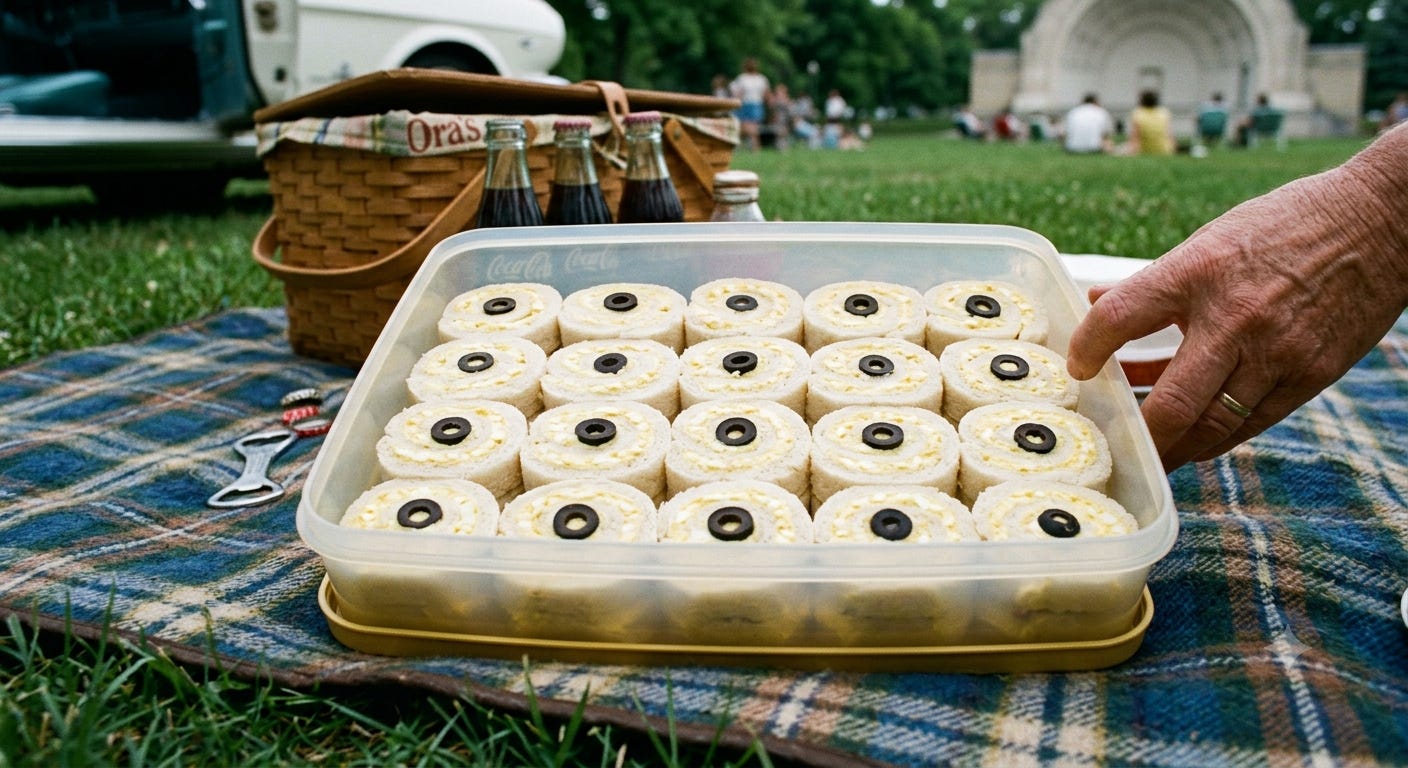
I make egg salad and spread it onto the long slices of bread, laying down rows of black olives on the edges and rolling them up into little logs, which I’ll chill and slice, creating perfect pinwheel sandwiches with black-olive centers.
With the egg salad logs resting in the fridge, I run next door to check on Edith. She’s still dozing, so I nudge her shoulder. Her eyes open slowly, and her jaw sags, her breath loud like she’s still asleep.
“We’re going to a concert,” I tell her.
“A concert?” she asks, her words stretched and slightly slurred, like worn-out tape.
“That’s right. We’re going to Como Park with my friend, Paul.” He’ll be here any minute in his ‘66 Mustang in Wimbledon White, with the specially-ordered aqua interior. Suddenly, I’m imagining myself reminding Paul that bringing Edith to the Park was his idea. I sling an arm around her waist to haul her to the bathroom and hold my breath while she plops on the toilet, praying I won’t have to do this again until after we bring her home.
I get Edith settled back into her recliner and tell her to sit tight while I run home, slice the egg salad logs into pretty pinwheels, and arrange them in a Tupperware tray I bought from a coworker when I was still working the switchboard at Cream of Wheat. That’s one nice thing about retirement: you don’t get invited to buy-useless-crap parties thrown by girls trying to make a quick buck.
I fish three glass bottles of Coke out of my fridge, though I’m sure Edith won’t want one, and tuck everything into a fabric-lined wicker picnic basket, a wedding present from my friend Ora. My late husband, George, and I must have eaten a million sandwiches out of this thing.
A brilliant white glow fills my porch window as I step outside with my picnic basket. Paul steps out of the car, his hand on Baby’s roof as he smiles.
“Pop the trunk,” I say. With the picnic basket tucked away, Paul follows me into Edith’s house. In the low light, Paul tosses me a sidelong glance.
“Let’s go, Edith,” I say, waking her again. “This is my friend, Paul.”
She says nothing, and I search Paul’s face for any sign that he’s ready to back out of this plan.
“I hope you’re ready for some great music, Edith,” he says, and I’m perplexed, but I keep it to myself.
Paul helps her out to the car, and I buckle her in. On the drive to Como Park through St. Paul’s verdant streets, I let myself forget for a moment what a terrifically bad idea this is.
At the park, we find some soft grass near the bandshell, and Paul eases Edith down into it. I spread a blanket and set my tray of sandwiches on top of it.
“Nobody makes egg salad like you, Mattie,” Paul says. Edith nods and gobbles several of them while Paul pries the caps off the Coke bottles.
The band kicks off with “The Foshay Tower March,” and Edith claps along, grinning, and the tension in my shoulders starts to loosen a little. Paul claps with her, bobbing his head, and my heart warms a little. I sip my Coke and thrill at its cold crackle. The first Coca-Cola I ever had was with George, at a soda fountain on Nicollet Avenue, after the Millers defeated the Toledo Mudhens, 6-2. We perched on stools in the dimly lit store, where a wide green awning covered the window during baseball games; they’d suffered broken glass on more than one occasion from balls hit out of the park. The druggist spooned thick brown syrup over crushed ice, then flooded the glasses with shimmering soda water. As much as I still love a nice cold Coke, nothing will ever match that first sip.
The band plays “Habanera” from Carmen, a mambo, and an arrangement of “Yesterday” by the Beatles. A person my age isn’t supposed to like them, but I’ve always found their music catchy, if a bit strange at times. To top it off, the one they call George reminds me of my George. (He hated the Beatles, but he also hated every song written after 1925). I’m sorry they’ve broken up.
Edith tugs on my sleeve, and from the droopy-eyed look on her face, I can tell I’ve got to find her a bathroom. I help her up and rush her toward the bathroom that’s just uphill, gripping her waist tight so I can keep her moving when she stumbles over her own feet. We enter the grimy tile bathroom, and I’m relieved we made it on time. I lock the stall door and bend to reach for the hem of her dress, and that’s when she gushes. Everywhere. It’s all down the front of her dress, the floor, my shoes. Yellow pee puddles on the floor, filling in the floor’s grout lines.
“Fuck,” I say. It’s an ugly, dirty word I never use and would have been slapped for saying when I was a kid, but if there was ever a time to use it, it’s when there’s piss everywhere.
I sit Edith on the toilet and go looking for paper to sop it up, but the hand dryers are those endless thin fabric towels, the kind that you yank on, and that never seem clean.
There’s a girl of about twelve at the sink, and I turn to her and ask, “Honey, can you get me some paper?”
“What kind?” she says.
“Any kind,” I say. “Just make sure it’s a lot.”
I don’t bother with toilet paper because I know it will just dissolve. The girl comes back a few minutes later with a stack of concert programs. I use them to soak up what’s on the floor and blot Edith’s clothes, holding my breath again as I try to wring them out.
To the girl I say, “By the bandshell, there’s a white-haired man sitting on a checkered blanket. Can you take some of those programs to him? Tell him Matilda will explain later.”
She nods and scampers off. Sweet kid.
When I’ve exhausted the programs and stuffed them into the trash, I bring a damp, crying Edith back to where Paul is sitting and let him know we’ve got to leave. I glance around and can see people wrinkling their faces in disgust.
I put down a layer of programs on Baby’s back seat. When we get in the car, Paul says, “It smells like the sidewalk in front of Moby Dick’s,” he says. Or the Faust, I think, but I don’t say it out loud. I don’t need him knowing about my weekly dirty movie at St. Paul’s notorious porno house.
“I’m so sorry, Paul.”
“Don’t apologize, Mattie. It’s not your fault. I’ll just have the car detailed tomorrow. But you can’t keep this up. It’s not your job, and I can tell you hate every minute of it.”
I glance at Edith, hoping she hasn’t heard. She’s asleep.
Paul helps me get Edith into the upstairs bathroom and waits in the hall while I fill an old clawfoot tub and peel off her pissed-on clothes.
Once she’s cleaned up and tucked in bed, Paul and I stand in her kitchen, speaking in low voices.
“You’re right,” I say. “I can’t do this, and I don’t want to do it. But I can’t just stop. If something happens to her while she’s alone, I’ll get the blame.”
Paul nods soberly. “You should hire a private nurse and send the bill to Edith’s family.”
For a moment, this seems like a great idea, until it occurs to me that Edith’s family might not pay it, and then I’d be stuck with a hefty debt.
“How about this: go through her address book and call everyone in it until someone steps up.”
“Worth a shot,” I say, though I don’t exactly feel like doing that either. I find a small leatherbound book near Edith’s rotary phone and dial. As I listen to the phone ring, I catch a glimpse of something gleaming in the back of her desk drawer, and when I realize what it is, I nearly fall off the chair: it’s my necklace with the green glass squares, the one George gave me for our anniversary.
What in blazes is this doing here? I’m so distracted that when I hear another voice on the other end of the line, I almost forget to speak.
Author’s note: The Untamed Life of Matilda Pepper is a novel in progress; you can read the rest of it here.
Poor Mattie
Darn it, I was hoping this was going to turn out well.
I've never heard of or seen a loaf of bread sliced lengthwise, though makes perfect sense here.