
Hand Pulled Noodle
The Untamed Life of Matilda Pepper

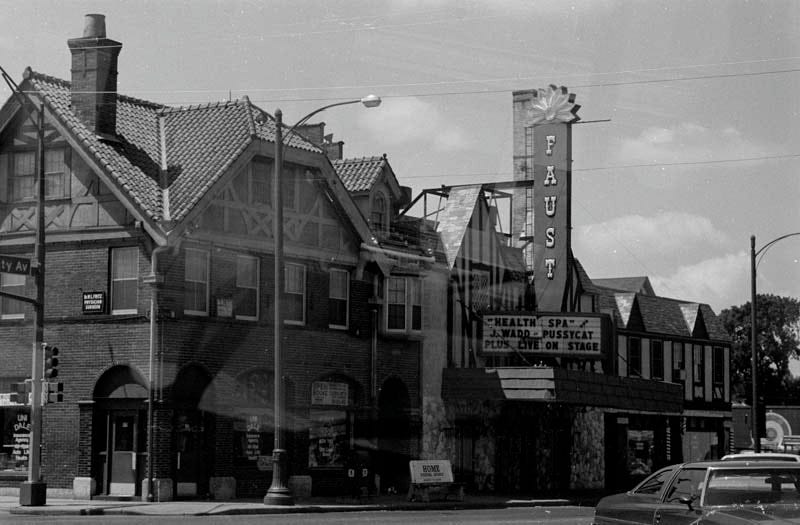
The Faust is an odd building: rambling brick with half-timbering and terracotta roof tiles, an unfortunate crossbreed of Mediterranean and Bavarian styles. A sunburst crowns the vertical signage that spells out F-A-U-S-T, and the marquee advertises the latest movie: Hand Pulled Noodle. The concrete in front of the theater has piss permanently baked into it, and the reek is particularly bad on humid days like this.
Inside, water bubbles from the six-foot marble phallus and trickles down to a coin-filled pool below. The girl with the em dash face is behind the counter, flipping through a Spanish grammar book. She looks like she’s still in high school, and I’m surprised her parents let her work here, but I don’t ask because it’s none of my business.
I show her my Golden Age card and she hands me my change and a ticket. I’m still irked that the Vice Squad took it upon themselves to abscond with Deep Throat. I wanted to see what all the fuss was about. And you just know that they all had a private screening of it somewhere in the bowels of the Ramsey County jail.
I wonder how much evidence goes missing — how many gangsters’ molls lose their ruby rings to police seizures, only for those same jewels to end up on the fingers of detectives’ wives?
The theater darkens, and the film begins to flicker, showing a dark, desolate street with little light except for the greenish glow emanating from the windows of a Chinese restaurant. A lurid neon sign advertising hand-pulled noodles blinks just above a row of neat, white cafe curtains. Inside, the restaurant is empty, its Formica tables stacked with neglected dishes and bits of leftover food. Beyond a pair of swinging doors is the kitchen, where a chef is teaching a waitress in a skimpy uniform how to make noodles by stretching and tossing the dough. He stands behind her, guiding her hands, until he begins to grind on her, and the lesson turns into him showing her how to pull a different noodle.
When the camera zooms in on their faces, it’s obvious that the actors aren’t Asian. I can see the tape, plain as day.
When the movie is over, I buy a box of popcorn from the em dash girl and wait for the bus across the street. Inside the bus shelter, a man is hunched over, reeking of whiskey and half asleep. He’s got a nose so big, he could park a Matchbox car in each nostril. I steer clear of the shelter and lean into the street, trying to catch a glimpse of the bus.
If anyone knew I came to the Faust regularly, they’d ask why I come all the way to St. Paul when Minneapolis has its own smut venues. I suppose I’m no different from anyone else who likes dirty movies: I don’t need people giving me the look. At least this way, I only get the look from the em dash girl.
When the bus pulls up, I get on, while the man in the shelter barely moves, and the bus drives off without him. I sit up front so I can chat with Wilbur. He tells me a story from when he was a boy growing up in Charleston, how he had to use a separate window at the box office, and how the lady who took his money would pinch it between two fingernails like it had been rolled in dog crap.
“I hope things are better for you now,” I say.
“In some ways, they are,” he says. “In some ways, they’re the same.”
A greasy-haired girl in a granny dress gets on, a blue haze of marijuana trailing her as she makes her way to the back of the bus.
“What have you got going on this week?” he asks me.
“Church rummage sale with my friend Ora, Ice Follies matinee with my friend Paul.”
Wilbur grins in the rearview mirror. “You always find so many things to do.”
I nod silently. I learned a long time ago that all you can do is look at what’s available to you and connect the dots. Because that’s what life is, really: connecting the dots.
At the rummage sale, Ora and I pick through piles of handmade pot holders and dolls with missing limbs. It’s always funny to me, the strange items people think might be worth something to somebody else.
“What’s this doing here?” Ora says, picking up a silver tray. “This is mine!”
“You sure?” I ask.
She points to where her name is engraved on it. Ora & Tomas, 1919. A motif of oak leaves and tiny acorns surrounds the names. I catch my reflection in the shine, and quickly check to see if my lipstick is smudged.
“You didn’t donate it?”
“Hell no!” She shouts, and I glance around, hoping no one heard. These bohemian church ladies can get into such tizzies over swearing.
“I had just finished polishing it,” she says, “and it was sitting on my kitchen table next to the box of things I’d packed for the sale. The girl who came to pick it up must have thought I wanted her to take the tray too.”
“And you didn’t notice it missing?”
“I thought I put it away,” she says, tucking the tray under her arm and stomping off to yell at somebody.
I wander over to a table full of cast-off jewelry. It’s mostly pins: Day-Glo enamel daisies and bright red Bakelite cherries. I find a necklace of squares of red glass dangling from a silver chain, and I feel a chill. I had one just like this, only the glass squares were blue, a gift from my late husband during the Depression, when you were lucky if you could afford glass gems or celluloid ivory or whatever other cheap imitation of glitz jewelers came up with.
That necklace slipped off my neck one day and I never did find it, even though I dumped out every drawer in the house, dragged every piece of furniture away from the wall, pulled up the car’s floor mats, interrogated the staff at the Red Owl, and consulted the lost-and-found at church at least three times.
“Mattie, it’s just glass,” George said. “I can replace it with a nicer one, something with real emeralds.”
“I don’t want real emeralds,” I said, “I want my necklace.”
George had given it to me on our tenth anniversary, and apologized for the stones not being emeralds then, too. That was the thing that annoyed me about him: he’d explain why something wasn’t good enough while giving it to you. If I told him once, I told him a thousand times to knock that off.
The worst of it was before we got married. We were engaged in ‘18 when he shipped out to fight in France, but when he came back, he wanted to call it off. When I finally got it out of him, he told me it was because he’d been injured and was “not a real man anymore,” and it wouldn’t be right to marry a woman when he couldn’t give her children.
I said all I wanted was his last name, and in 1920, we finally tied the knot at the Swedish United Brethren Church.
And then, ten years later, after days of stifling humidity, the heat broke as a storm rolled through, black clouds blotting out the afternoon sun. We lit candles in our small parlor, and I put a small roast on the table with a bowl of steaming spätzle, and as the necklace glittered in the candlelight, I realized George and I both had jobs, and each other, and were lucky.
Whenever I wore that necklace, I thought of candles, and rolling thunder, and of waltzing with George on our little private dance floor and the music on the radio faded in out of static.
“You’re not buying that cheap piece of junk, are you?”
I turn to see Ora standing next to me, eyeing the red glass necklace.
“No,” I said. “I was just taking a little trip down memory lane. Did you get everything sorted out with your tray?”
“Yes,” she says, “but not before they tried to make me pay for it! They said I ought to pay anyway for the good of the church. Charity and all that. I told them I oughta do like Jesus and flip tables.”
“I don’t think Jesus would have flipped out over a silver tray,” I say.
“Anyway,” Ora says, “Martina Fiala came over and said they should give me my tray back, since the same thing happened last year with Eva Hlavac’s Blue Willow pitcher, and she got it back without paying, so it’s only fair I get my tray back.”
“What’s with this church?” I ask. “How do the wrong things keep ending up in your rummage sales?”
Ora shakes her head. “These kids today,” she says. “They don’t listen. Well, what do you say we get some coffee?”
“Are you sure you need any?” I tease as we head to the pass-through window where there’s a large hissing coffee urn and trays of sugar-dusted cookies.
An hour later, we leave the sale empty-handed. I walk Ora back to her house, where she puts her silver tray back in its rightful place in her glass-fronted curio cabinet. After lingering on her shady porch a while, I head home, thinking I should look for that necklace again, but I decide against it. You never find the thing you’re looking for while you’re looking for it. You find it when you’re looking for the next missing thing.
A week later, the feature at the Faust is a follow-up to Hand Pulled Noodle, called Dumpling Dive. This installment, set in the same lurid chop suey joint, opens with a long-haired hippie who comes to pick up a takeout order, but doesn’t have enough cash. The cashier hops onto the counter next to the cash register and lets him pay by stuffing his head up her skirt.
Outside, on the piss-rancid sidewalk, I light a cigarette. A young man, perhaps in his forties, exits the theater, a gust of cold air trailing after him. He asks if he can bum one, and I hold the pack out to him.
“I’ve seen you here before,” he says. “Why do you always come here?”
“Why do you?” I ask.
“It’s different,” he says.
“I don’t think so,” I say. “I think it’s the same.”
“I just can’t imagine…if my mother came here…”
“Do I look like your mother?”
“You must be somebody’s mother.”
“Well, I’m not.”
“Oh, maybe that explains…”
“Jesus,” I say, cutting him off. “Didn’t your mother teach you about minding your own damn business? That goes double for someone who’s done you a favor, by the way.”
The wind shifts and the piss is temporarily covered by the smell of charred wood: another arson, probably. The St. Paul city council will no doubt blame it on the Faust. The mere existence of this theater spawns all manner of crime, they say.
“Did you see Deep Throat?” I ask.
“No,” he says.
“Too bad,” I say.
“A buddy of mine says he knows a guy who has a bootleg copy, and he’s got a projector too. For five bucks, he’ll screen it in his garage.”
I stare at him, hard. Lines on his forehead. Pouchy eyes. A slight yellow tinge to his sclera. Stubble concealing red, pus-capped acne. A grease-smudged t-shirt under an unbuttoned flannel. He looks like he got kicked out of the pipefitter’s union for blowing his dues money on cheap lap dances. And he dares to question my habits?
“Is that right?” I say, blowing a stream of smoke in his general direction.
“I can call you with his information if you want,” he says.
I hesitate. I don’t want this degenerate having my phone number. Then again, he’ll probably forget all about it once he passes out in whatever flophouse he lives in. I tear off part of the cigarette pack and scribble my number on it. He stuffs it in the pocket of his flannel shirt and I cross the street to catch the bus.
Author’s note: This piece is part of a novel in progress, albeit totally out of order and disjointed. See other installments, which will one day fit together in a way that makes sense, below.
Everyone has something that makes them want to flip tables. For some it's moneychangers, for others it's a silver tray. If I ever raise hell at a house of worship, I'll let you know what the trigger was.
There is some wisdom in there. Enjoying this, whether it's out of order or not. I like the "em dash" girl.