
Carimona
A story of a ghost town.

Carimona.
The name echoed in Otto’s mind, like a tune you couldn’t forget. It would be a pretty name for a baby girl or a foal, but Otto didn’t have either.
The sound of cards slapping the surface of an old wooden table filled the rec room of the Beaufort Hotel. Poker wasn’t allowed at the Beaufort because it led to fights, and then Joey, who ran the place, would get out his blackjack and cave in a player’s head. The men played War instead, or Hearts, or other games that Otto didn’t know the rules to.
“Otto, it’s your move,” said Percy, a Lucky Strike quivering on his lower lip.
In the corner, an old walnut Philco cathedral radio played the broadcast of a Millers game; between pitches, the announcer mentioned that Willie Mays had been called up to the Majors and was on his way to the New York Giants. Sunlight streamed through dirty windows that were just below the ceiling, low enough to let light in but too high to let you look out. Smoke curled in the shafts of light as a dozen half-smoked cigarettes smoldered in a grimy glass ashtray.
Otto put down a seven of hearts, and the other men laughed. “Is that all you got?” Percy teased, doubling over as a cough killed the other half of his smart-alecky remark, his face turning scarlet and veiny.
“Deal me out,” Otto said, smoothing out his shirtfront as he stood up. The Beaufort had rules about what a man could wear. Otto’s shirt was wrinkled, sure, and the armpits had yellow stains that wouldn’t come out even after soaking in Borax, but at least he wasn’t a slob like the bums who lived in cages at the Pioneer Hotel or the Victor, flophouses where men slept under chicken wire and had flimsy walls between them.
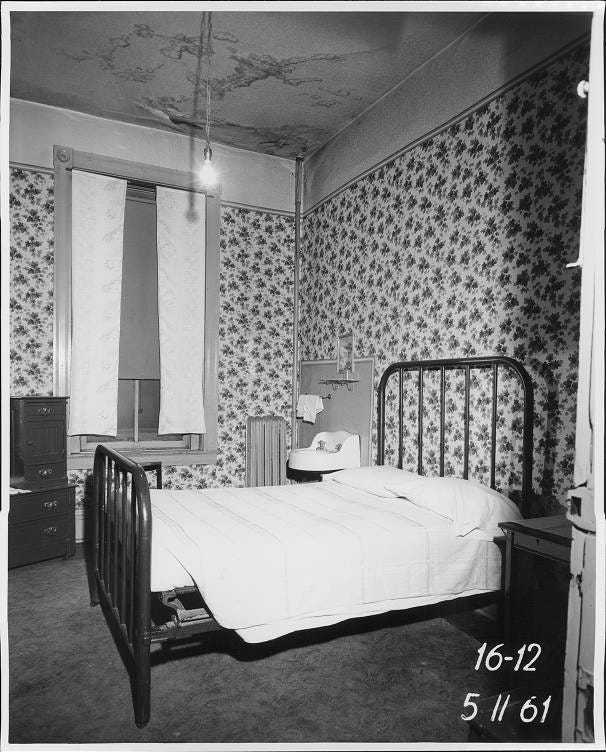
At the Beaufort, you had a proper room with a brass bed, a sink in the corner with a small mirror above it, a chest of drawers and even a window shade. Otto’s room had wallpaper with ivy printed on it. The green was faded, and the ceiling had brown water stains, but it at least he didn’t go to sleep staring at chicken wire.
Otto pushed past the double doors that separated the recreation room from the lobby and breathed in air that wasn’t quite as smoky.
“Morning, Otto,” Joey said as he sat behind the check-in desk, tapping a folded newspaper against the counter. A massive brass cash register sat behind him, giving off a dull gleam, dust gathering in the contours of its bas relief grape clusters.
“Hey, you want to see something?” Joey asked. He tossed the newspaper onto the counter and reached for something underneath. Otto glanced at the folded newspaper and saw the words “Daily Racing Form” across the top of the page.
“Look at this,” Joey said, handing Otto a postcard. “It’s from when this hotel was new-ish, about 1900.”
Otto studied the postcard, a black-and-white snapshot of the same room he was standing in. The postcard showed a glass case full of stationery, a mahogany check-in desk, a leather borne settee, and ferns. The glass case, fancy desk and ferns were long gone, and a long, fluorescent light had replaced the chandeliers, but the pressed-tin ceiling and mahogany wainscoting remained. The same leather borne settee, round with a tufted-button back, sat in the middle of the floor, but hardly anyone used it now.
“Would you look at that,” Otto said, and read the text on the bottom of the card. “‘Modern, European, Moderate Prices.’” Otto’s Beaufort did offer moderate prices, but it sure as hell wasn’t modern or European. He chuckled as he handed the card back.
As he stepped out onto the street, Otto felt the humidity cling to his skin and he wanted to shed his button-up shirt and sport coat, but he was a gentleman, and gentlemen didn’t walk around in undershirts.
“Otto,” a voice said, and he turned to see Percy standing behind him on the sidewalk. “Wait for me.” The stench of urine rose from the pavement, mingling with the damp air. Next door, Acme Typewriter had the door propped open, and they could hear the clacking of keys and the ding! of a carriage reaching the end of the line.
“Percy,” Otto said, “You ever hear of a town called Carimona?”
“No,” Percy said. “Can’t say as I have.”
“It’s way down near the Iowa border,” Otto said. “Used to be a stop on the Dubuque Trail. Stagecoaches would stop there for fresh horses on their way up to St. Paul from Iowa.”
“Stagecoaches, huh?”
A few blocks from the Beaufort, they crossed the street to avoid a bunch of people standing in a circle in front of a mission, praying while one man stood on a chair, waving a pocket-sized bible in the air.
“How’d you like to kick that chair from under him?” Percy asked, speaking out of the side of his mouth but still loud enough for the holy rollers to hear. A woman with a white, cherry-print kerchief glared as the two men passed.
“I bet there are no nosy street preachers in Carimona,” Otto said.
“How do you know that? You ain’t never been there.”
“No,” Otto said, “But I know it’s far from here, and in the country, and the air is cleaner. I bet it’s the kind of place where a man can have a drink in peace, and the church ladies mind their business, unless you’re down and out. Then, they bake bread and just bring it to you. They don’t make you get on your knees for a deviled ham sandwich like the mission preachers do.”
“I hate deviled ham,” Percy spat. They rounded a corner where a wartime hit by the Andrews Sisters rang from a bar’s jukebox.
At a dim cafe, baskets of boiled eggs and hardening caramel rolls sat on the counter. They ordered lamb stew with spaghetti, but the man behind the counter said he’d run out of both, so the two men settled for twenty-cent summer sausage sandwiches and ten-cent coffee.
“I bet in Carimona, we could get a whole lamb,” Otto said.
“And we could build a big fire, and roast it over a spit,” Percy said. “And when Indians come to raid the town, we could invite them to share the lamb with us.”
“Every day is Thanksgiving in Carimona,” Otto said.
After lunch, they sprawled in the grass of a triangular park, where other men lazed, passing wine bottles back and forth.
“I bet Carimona has pretty houses, big ones, with porches,” Otto said. He stared at the sky while crab grass poked the back of his neck.
“With apple trees in the yard,” Percy added, “with apples that fall right into your hand when you walk by.”
“We oughta go down there,” Otto said.
“Let’s get the train,” Percy suggested.
“Trains don’t stop there,” Otto said. “We’d have to hire a car.”
“I know where we can get a car,” Percy said. “Give me a nickel for the phone.”
“Save your money,” Otto said, shaking his head. “Your daughter isn’t going to let you use her Studebaker.”
“How do you know?”
“Because she never lets you use it. She won’t even drive it down here.”
“Maybe she will if I tell her where we’re going,” Percy said. “She’d like Carimona.”
“Nah,” Otto said. “We’ll get a car from somebody else.”
Later, in the blue velvet twilight, the marquee lights of the Persian Palms burned white hot, and the two men counted their money before going inside. They couldn’t afford to get jackrolled or busted out, not if they wanted to make it to Carimona.
They ordered bottled beer and turned down a B-girl with a brassy blonde ponytail and a broken front tooth. A glass water tank stood on the stage, and a woman inside it twisted out of her top, revealing two sequined starfish pasted over her nipples, her dark hair swirling above her.
“I don’t suppose we’ll see that in Carimona,” Percy said.
“No,” Otto said. “I suppose not. But I’m sure the town is full of nice, sweet ladies.”
“Carimona?” A man in a denim work shirt interjected. Otto could tell he was a farmer. Men like him came to the city all the time to sell prize pigs at the fairgrounds, then blow all their money on a night at the Palms.
“There’s no town in Carimona,” the farmer said.
“There is so,” Otto argued.
“No. Hasn’t been since the end of the stagecoach era. The railroad company wanted to lay track through the town, but wanted the town to pay a bonus. The town wouldn’t pay. They were sure the railroad company would have no choice but to lay track through the town anyway. But when they laid the track, the railroad skipped Carimona altogether, and the town just died out. It was a ghost town thirty years ago. Empty buildings with roofs caving in. The old store was burnt. Now it’s not even that. You can find ruins here and there, but no town. No town at all.”
The farmer walked away, laughing.
Otto and Percy walked back to the Beaufort in silence. Alone in his ivy-wallpapered room, Otto bent over the porcelain sink and washed his face and armpits. After he dried his face, he looked at himself in the small mirror above the sink. Deep grooves ran across his forehead and creased his cheeks. Thirty years ago, he’d been a young man working for the railroad as a porter. Had someone told him about Carimona back then? Had he remembered the name, but forgotten the story?
He yanked the cord to shut off the naked light bulb that hung over his bed and sank down onto the old mattress. Even in the dark, he could see the faded ivy on the walls. He pictured Carimona as the farmer had described it: sagging, skeletal, deserted.
He remembered the way the farmer’s shoulders shook as he walked away, laughing.
If I’d had Joey’s blackjack, Otto thought, I’d have bashed his head in.
Author’s note:
I recently learned that Carimona was a town in southern Minnesota that served as a stop for stagecoaches. It was a bustling town in the 1840s, but by the 1920s, it was a ghost town. More to come in a future post!
“Carimona” is set in the Gateway District, a section of Minneapolis that was a skid row until the city demolished nearly all of it. To read another story in the same setting, check out The Pioneer Hotel, originally published in the Lowestoft Chronicle.
Of course I had to find it on a map. It does seem to be the middle of nowhere. Looking forward to more!